

What You Actually Do
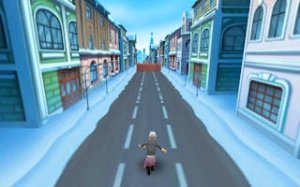
Festival Run Arcade is an endless runner. You control a single character who moves forward automatically through a bright, festive environment. Your only inputs are left and right—touch on mobile or keyboard on desktop. The entire challenge comes from reading the path ahead and shifting lanes at the right moment. There is no attack button, no jump mechanic mentioned, and no combat system. The game strips the runner formula down to dodging and reaction speed.
Obstacles and Escalating Pace
Three obstacle types appear along the route: solid walls, sharp iron sheets, and giant fruit characters that block the path. Each demands the same basic response—move aside—but their placement and spacing change as the run continues. The game speed increases over time, which compresses your reaction window. Early on, obstacles are spaced far enough apart that almost any player can weave through them. Later, the gaps tighten and the screen scrolls faster, turning a simple dodge into a test of anticipation. Hitting any obstacle ends the run immediately.
Why the Difficulty Curve Works
The game is easy to start and hard to master. That phrase gets overused, but here it describes a real design choice. Because there are only two inputs, new players understand the controls in seconds. The difficulty comes from pattern recognition and timing, not from complex rules. You learn to scan the path ahead rather than react to what is directly in front of you. That shift—from reacting to anticipating—is the skill the game actually tests. Short sessions work well because concentration fades quickly once the speed peaks.
Who This Is For
Festival Run Arcade avoids weapons, violence, and mature themes. The visual style is colorful and the obstacles are stylized rather than threatening. That makes it suitable for younger players and for adults who want a low-commitment reflex challenge. Score sharing with friends adds a light competitive layer without requiring multiplayer infrastructure. If you prefer games with narrative depth, character progression, or strategic decision-making, this runner offers none of those. It is a pure reflex loop: run, dodge, fail, retry, improve.



Comments
0 comments