
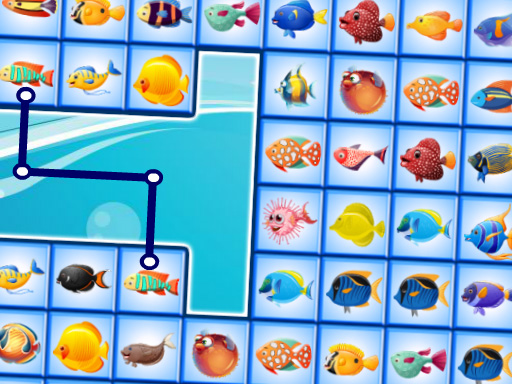
The Connection Rule That Defines the Puzzle
Aquatic Tile Match Puzzle follows the familiar Mahjong solitaire formula of removing identical pairs, but adds a spatial constraint that changes how every move is planned. Two matching tiles can only be cleared if a path connects them, and that path may contain no more than two 90-degree turns. The path also cannot cross over any other tile still on the board. This means a pair that looks obvious at first glance may be impossible to remove until surrounding tiles are cleared.
How a Round Plays Out
Each level presents a different arrangement of tiles. Players scan for identical pairs, then check whether a valid path exists between them. The two-turn limit forces forward thinking: clearing a tile in the center might open a route for a pair near the edge, while removing an outer tile could block a path you were saving for later. A timer runs throughout each stage, and finishing faster earns bonus points. Controls are simple tap or click actions, so the challenge comes from reading the board rather than executing inputs.
Progression and Difficulty
Later levels introduce more complex tile arrangements that make valid connections harder to spot. The difficulty curve is tied to board layout rather than new mechanics, so the core rule stays consistent while the planning required grows. This keeps the game approachable for newcomers while giving puzzle veterans something to work through.
Who This Suits
The aquatic theme and calm pacing make this a low-pressure option for players who enjoy Mahjong-style puzzles. The timer adds a light layer of pressure without turning the game into a reflex test. Anyone who likes pattern recognition, spatial reasoning, and steady progression will find the format familiar but not identical to standard tile matching.










Comments
0 comments