
Matching and Merging Mechanics
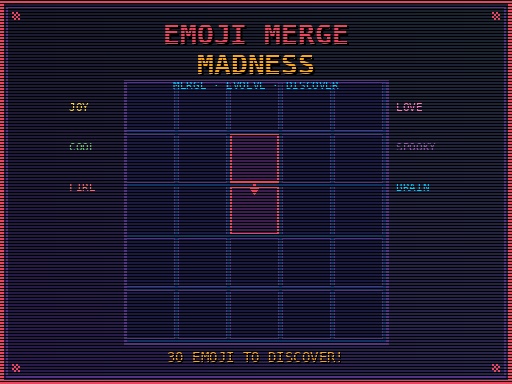
Players select two adjacent tiles showing the same emoji. That pair combines into the next emoji in its evolution chain. Each chain has five tiers, so reaching the top requires repeated merges. The board starts full, and every merge frees space while advancing one tile. Points come from consecutive merges, so a single move can trigger a chain reaction if planned well. The game ends when no adjacent matches remain.
Evolution Chains and Discovery
Six distinct evolution chains run in parallel, each with five tiers, for a total of 30 unique emojis. A discovery tracker records which emojis you have unlocked, giving a clear long-term goal beyond a single session. Because chains are independent, progress in one does not block another. Focusing on one chain at a time can be efficient, but spreading merges across chains may keep more of the board open.
Scoring and Strategic Depth
Combo scoring rewards players who merge multiple pairs in quick succession. The exact multiplier depends on how many merges you chain before the streak breaks. This makes board position matter: merging near the center often preserves more future options than merging at the edges. Choosing between a high-tier merge and a low-tier one that sets up a combo is the core decision. Thinking two or three moves ahead separates high scores from average ones.
Visual Style and Session Length
The retro pixel art gives the game a nostalgic look, and the simple tile design keeps matching easy to read. Sessions can be short or long: a single board takes only a few minutes, but the discovery tracker encourages returning to unlock all 30 emojis. The game suits casual players who want a low-pressure puzzle and dedicated players who chase combo records.








Comments
0 comments